I want to level with you for a second:
Most business owners think SEO is about websites, keywords, and rankings.
They think “local visibility” means Maps and a pretty Google Business Profile.
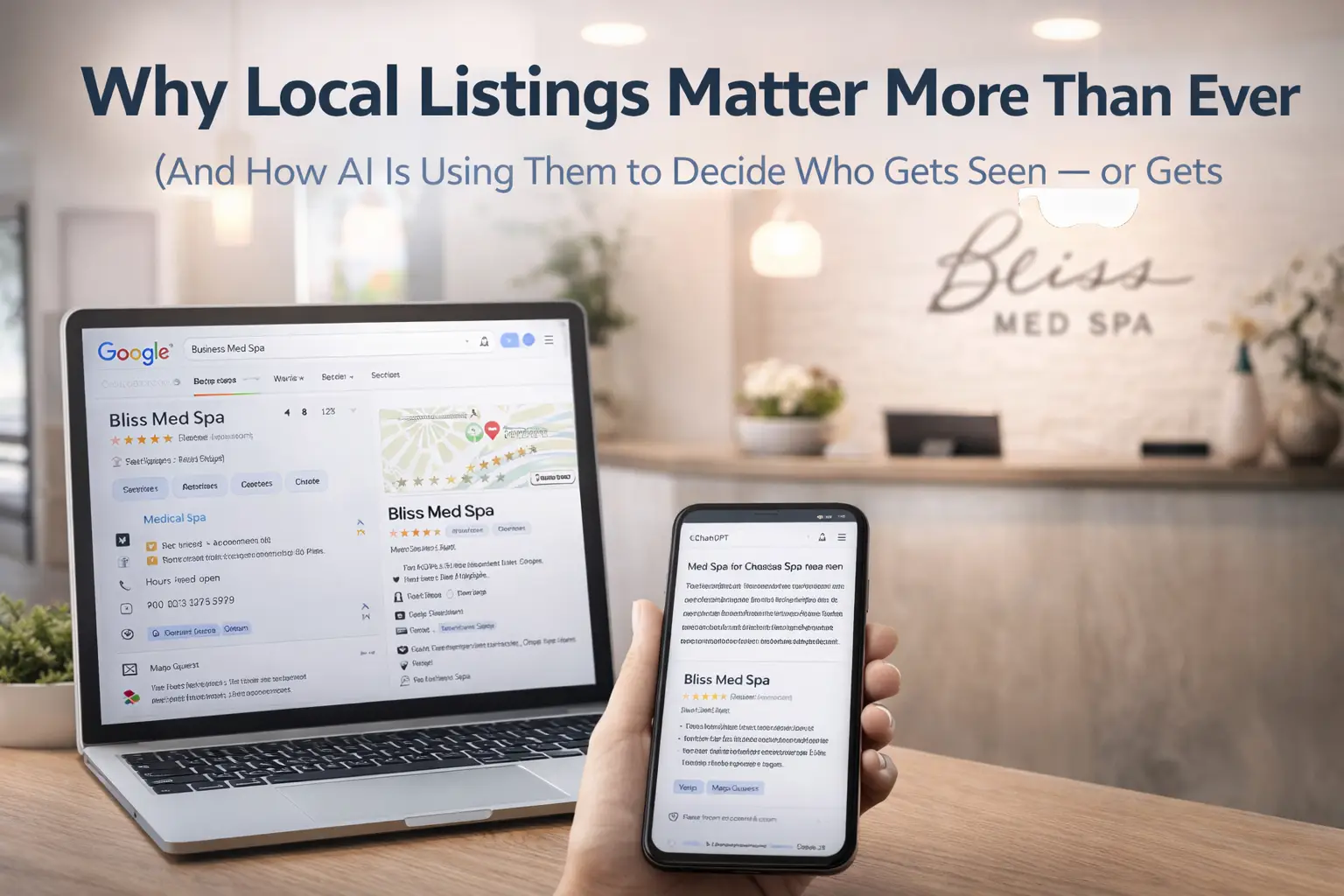
But we’re in a world where AI search engines are literally pulling business information from multiple directories and sources, stitching it together, and using that to answer real customer questions before anyone ever clicks through to a website.
If your listing profile isn’t accurate and consistent everywhere it should be, this shift doesn’t just hurt your visibility — it quietly erases your presence before the customer even sees your name.
What the Data Is Actually Showing
BrightLocal’s recent research confirms something everyone in the industry has been feeling:
AI search platforms — including ChatGPT, Gemini, and others — are relying on listings and citations far more than they used to.
Here’s the reality:
- AI systems are pulling from a variety of sources — not just your Google Business Profile, but also Yelp, MapQuest, Foursquare, industry directories, and niche citation sites.
- Yelp alone appeared as a data source in roughly one-third of searches in some tests, and often in multiple parts of the same query.
- Foursquare’s massive database is powering local results even though most businesses don’t think about it.
- Your own website still matters, and often gets cited directly — but listings and directories are equally critical.
Here’s what this tells us: AI isn’t just pulling a web page and summarizing it — it’s synthesizing across real-world data streams.
Why This Feels So Frustrating (And Why That’s Okay)
Let’s be honest — this is a change that feels abrupt.
One month you could optimize for local intent keywords, fill out your GBP, get some reviews — and you were in the game.
Now it feels like you need presence in two dozen places, and none of them talk to each other.
That frustration isn’t imaginary — it’s a real shift in how discovery works. Traditional search gave you multiple blue links. AI search often answers the question directly based on the best data it has, which increasingly comes from listings and citations.
Businesses used to compete on ranking.
Now they compete on data trustworthiness and availability.
And that’s a fundamentally different thing.
What You Need to Know About Listings Sources
Here’s what’s critical:
1. Your listings are data points, not marketing checkboxes
Directories like Google Business Profile, Yelp, Foursquare, MapQuest, and others aren’t just “nice to have.”
AI systems source structured business details from these platforms — and if the data is inconsistent, AI won’t know what to trust.
2. Accuracy and consistency are visibility currency
Your NAP — Name, Address, Phone — needs to be identical everywhere. Inconsistency doesn’t just confuse customers; it confuses AI systems too. Inaccurate listings can lead to your business being omitted or misrepresented in answers.
3. Reviews still matter — and AI reads them
Platforms like Yelp get leveraged not just for contact info, but also for review signals that help AI systems form sentiment and trust judgments about your business.
4. Industry-specific directories get more weight than you think
AI models often look to specialized citation sources — e.g., legal directories for lawyers, medical directories for clinics, franchise directories for hospitality — especially when general listings don’t provide depth or context.
5. Your website still matters — but not in isolation
AI will pull from your website — especially structured content, FAQ blocks, and clear business descriptions — but only if the listings ecosystem helps connect it to the business entity.
How This Changes What We Do (Strategically)
If you’re serious about local visibility in an AI world, the checklist looks different than it did even a year ago.
Here’s what actually moves the needle:
√ Look beyond Google Business Profile
Don’t treat GBP as the only listing worth optimizing. AI search engines use many sources — so you need presence everywhere the data could be pulled from.
√ Sync NAP across all major directories
Inaccurate data is worse than incomplete data. Inconsistency tells AI not to trust your business signal.
√ Prioritize review management everywhere
AI appreciates context — and customer sentiment is one of the strongest context signals.
√ Build and maintain niche citations
Industry-specific directories matter a lot because they add depth that general platforms don’t capture.
√ Make your website data “AI friendly”
If listings feed AI the core business facts, your website should reinforce and expand them in clear, structured ways.
The Bottom Line
AI search isn’t something that’s “on the horizon.”
It’s here, and it’s reshaping how local businesses get found and chosen.
The businesses that win won’t be the ones with the flashiest website or the highest rankings.
They’ll be the ones whose data is clean, consistent, complete, and trusted across every relevant source — and whose online presence mirrors reality in enough places that AI can stitch it all together.
That’s a different kind of optimization.
But it’s one that any business can do — if they treat their listings like the strategic assets they’ve become.