For years, search had a clear objective: rank higher.
If you could get to page one — or better yet, position one — everything else tended to work itself out. Traffic came in. Leads followed. Life was good.
That model hasn’t disappeared. But it has been quietly joined by another one.
Search Didn’t Die — It Split
What’s happening right now isn’t “SEO is dead.” It’s that search has fractured into multiple surfaces, each with its own rules:
- Traditional Google results
- Google AI Overviews
- Maps and local results
- ChatGPT-style answers
- Perplexity-style citations
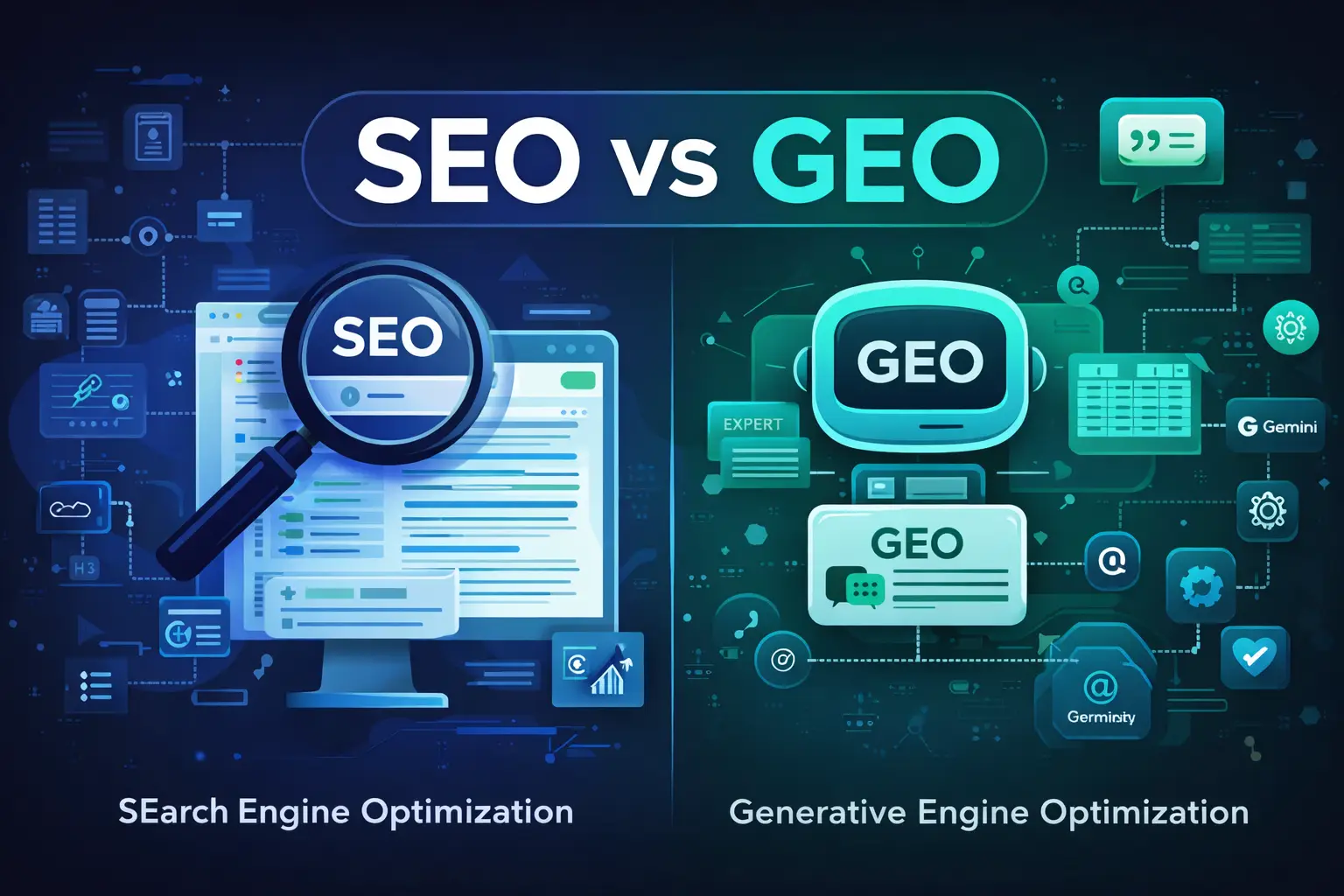
Some of those still reward rankings. Others reward trust. That’s where the difference between SEO and GEO shows up.
What SEO Is Still Great At
Let’s be clear: SEO still matters. SEO is excellent at:
- Capturing existing demand
- Ranking pages for known queries
- Driving clicks and traffic
- Scaling visibility
If someone knows what they’re looking for, SEO helps them find it. That hasn’t changed.
What SEO Was Never Designed to Do
SEO was never built to:
- Judge expertise
- Summarize opinions
- Weigh tradeoffs
- Recommend who to trust
- It ranks pages.
It doesn’t reason. As long as search was about lists of links, that was fine. AI changed that.
What GEO Actually Is (Without the Buzzwords)
GEO isn’t about “optimizing for AI” in the gimmicky sense. It’s about making your expertise legible to systems that summarize instead of index.
GEO focuses on:
- Clear definitions
- Direct answers
- Consistent viewpoints
- Structured information
- Attributable expertise
In GEO, the win isn’t:
- “We ranked.”
It’s:
- “According to [you]…”
Ranking vs Being Cited
This is the simplest way to think about it. SEO asks:
- “How do I rank for this?”
GEO asks:
- “Why would a system trust me enough to repeat this?”
Those are very different questions — and they lead to very different content decisions.
Why Length Matters Less Than Density Now
Traditional SEO rewarded depth and coverage. GEO rewards density and clarity.
AI systems prefer:
- One clear answer per question
- Tables over paragraphs
- Definitions over storytelling
- Specificity over polish
Long content still has value — but only if it earns its length.
How Research Changes
SEO research looks outward:
- What’s ranking?
- What’s missing?
- What keywords matter?
GEO research looks upstream:
- What does AI already answer?
- Who does it cite?
- Where does it hedge or stay vague?
The opportunity isn’t to rewrite what exists — it’s to say what’s missing.
This Is Why Strategy Comes Back Again
Notice the pattern.
GEO doesn’t reward:
- Volume
- Generic advice
- “Best practices” regurgitation
It rewards:
- Point of view
- Experience
- Judgment
- Consistency
In other words: strategy. Without a clear strategy, there’s nothing for AI to anchor to.
The Biggest Mistake Businesses Are Making Right Now
Most businesses are reacting instead of integrating.
They hear:
- “SEO is dead”
- “AI is taking over”
- “Content doesn’t matter anymore”
So they chase shortcuts.
The smarter move is simpler:
- Use SEO to get found. Use GEO to get trusted.
These aren’t competing approaches. They’re complementary ones.
What Winning at Both Actually Looks Like
Businesses that do this well:
- Still invest in SEO fundamentals
- Still care about rankings and traffic
- But also publish content that explains, commits, and clarifies
- Build a recognizable voice and author
- Update content intentionally, not endlessly
They stop chasing every keyword and start building authority around what they know best.
The Bottom Line
SEO helps people find you.
GEO helps people — and machines — believe you.
In a world where AI helps narrow choices before anyone clicks, belief is the new visibility.
Ranking gets you seen. Trust gets you chosen.
And the businesses that understand both will have a very unfair advantage.