
The Three Businesses Google Chooses to Show — and Why You’re Not One of Them
Twenty years ago, the Yellow Pages decided who got called. You paid for a bigger ad, you got more calls. Simple, transparent, and expensive — but at least you understood the rules.
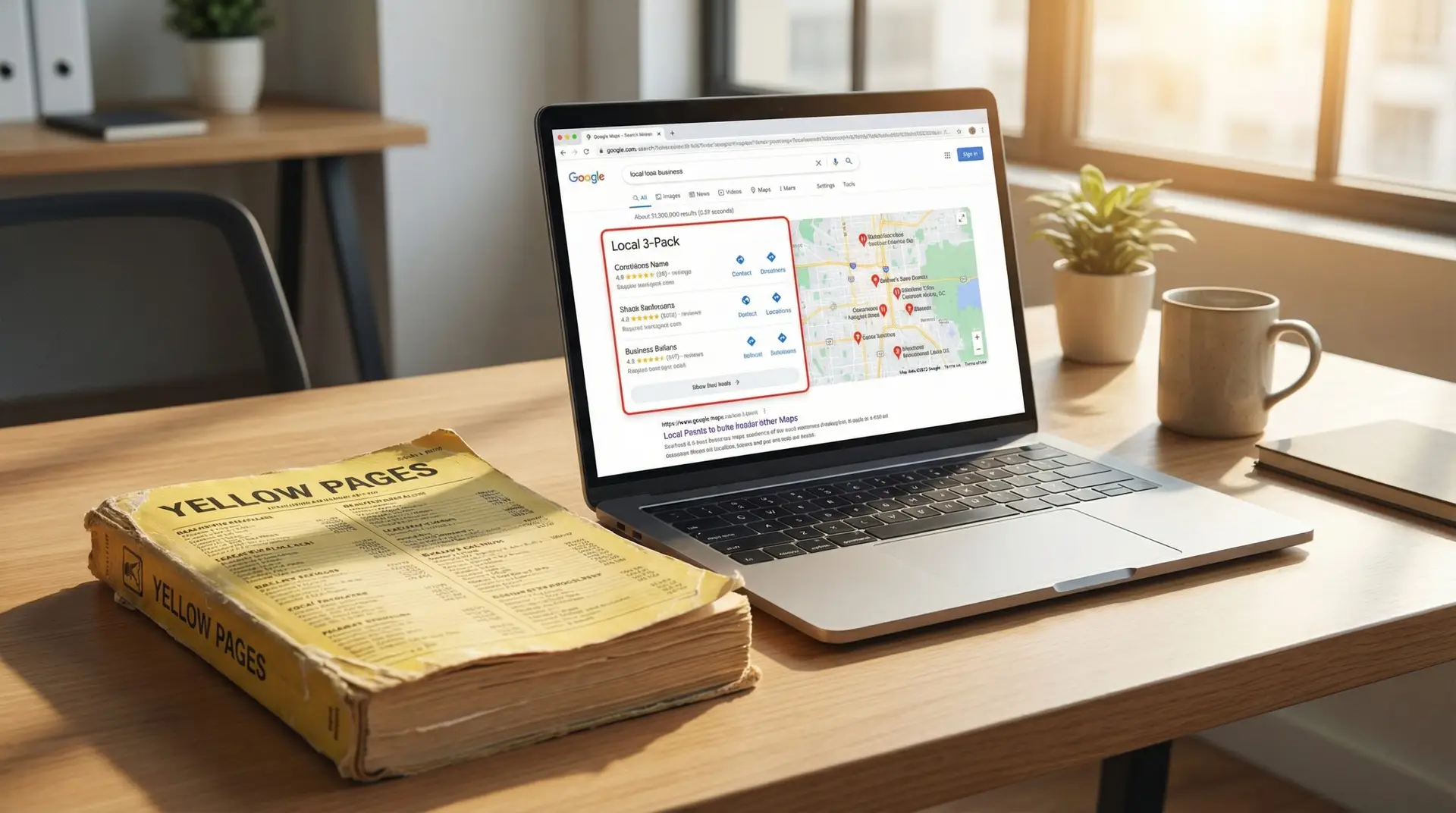
Today, Google’s local map pack does the same job. When someone searches “electrician near me” or “family dentist Albany,” the three businesses that appear in that map box at the top of the page get the overwhelming majority of calls. Everyone below gets what’s left — which, increasingly, is nothing.
The map pack is the new Yellow Pages. The difference is that the rules aren’t printed on a rate card anymore. Google decides who shows up based on signals most business owners don’t even know exist. And unlike the Yellow Pages, you can’t just pay to be there.
What the Map Pack Actually Is (and Why It Matters This Much)
The local map pack — sometimes called the “3-pack” or “local pack” — is the set of three business listings Google displays with a map at the top of local search results. It appears for virtually every search with local intent: services, restaurants, professionals, retail.
Here’s why it dominates: the map pack captures roughly 42% of all clicks on local search results pages. The first organic result below it gets about 8%. Everything after that fights over scraps.
For service businesses, the math is even more lopsided. When someone searches with urgency — “emergency plumber,” “locksmith near me,” “24-hour vet” — they’re calling whoever appears in that map box. They’re not scrolling to page two. They’re not comparing five websites. They’re tapping the phone number on the first listing that looks credible.
If you’re not in the map pack for your primary keywords, you’re not in the conversation. Full stop.
The Three Factors Google Uses to Rank the Map Pack
Google has publicly stated that local pack rankings are determined by three factors: relevance, distance, and prominence. Understanding these is the difference between guessing and strategizing.
Relevance is how well your business profile matches what someone searched for. This is driven by your primary and secondary categories in Google Business Profile, the services you’ve listed, your business description, and the content on your website. If someone searches “commercial HVAC repair” and your GBP only says “heating contractor,” you’re losing relevance points before the race even starts.
Distance is geographic proximity — how close your business is to the person searching. You can’t change your address, but you can influence how far Google considers your service area relevant. Businesses with strong local signals (consistent citations, location-specific content, locally relevant reviews) tend to rank across a wider geographic radius.
Prominence is Google’s measure of how well-known and trusted your business is. This is where most of the competitive battle happens. Prominence is built from review count and velocity, citation consistency across directories, backlinks to your website, brand mentions, and engagement signals on your GBP. It’s the factor most directly in your control — and the one most businesses are losing on.
Why Most Businesses Aren’t in the Map Pack (and Think They Can’t Be)
Most local business owners have a vague sense that “Google stuff” matters but assume the businesses in the map pack are there because they’re bigger, older, or just lucky. That’s rarely the case.
The businesses ranking in the map pack are usually there because someone — either the owner or an SEO professional — systematically optimized the signals Google cares about. Here’s what they did that you probably haven’t:
They picked the right GBP categories. Google offers hundreds of business categories, and your primary category is the single most influential ranking signal for the map pack. Most businesses pick a generic category and never revisit it. The competitors outranking you likely have a more specific, more relevant primary category — and they’ve filled in secondary categories strategically.
They built citation consistency. Their business name, address, and phone number are identical across Google, Yelp, Facebook, BBB, industry directories, and dozens of other data sources. Yours probably has variations — an old address here, a different phone format there, an abbreviation that doesn’t match. Every inconsistency is a trust signal Google deducts from your prominence score.
They have a review engine running. Not just more reviews — a steady flow of recent reviews. Google weights recency heavily. A business with 200 reviews but none in the last three months loses ground to a competitor with 80 reviews and five new ones this week. Review velocity matters more than review count.
They respond to every review. Google has confirmed that responding to reviews improves local ranking. It signals active management and engagement. If you have reviews sitting unanswered — especially negative ones — you’re leaving ranking points on the table and giving potential customers a reason to call someone else.
The Playbook: How to Get Into the Map Pack
Getting into the map pack isn’t mysterious. It’s methodical. Here’s the sequence that moves the needle fastest:
1. Audit and optimize your Google Business Profile. Start with your primary category — make sure it’s the most specific match for your core service. Fill in every attribute Google offers. Write a business description that naturally includes your primary keywords and service area. Upload high-quality photos monthly. Post updates at least weekly.
2. Clean up your citations. Run a citation audit to find every directory listing with inconsistent NAP (name, address, phone) data. Fix the mismatches. Suppress duplicates. Build new citations on authoritative directories you’re missing. This is unglamorous work, but it’s foundational — nothing else works well until your citation layer is clean.
3. Build a review generation system. Don’t wait for reviews to happen. Create a systematic process: follow-up emails after service completion, a direct link to your Google review page, and a team-wide habit of asking satisfied customers. Aim for steady velocity — a few reviews per week is better than a burst of 20 followed by silence.
4. Respond to every single review. Thank positive reviewers specifically (mention what they referenced). Address negative reviews professionally and offer to resolve the issue offline. This isn’t just customer service — it’s a ranking signal.
5. Build local relevance into your website. Create dedicated service pages for each service you offer. Create location pages if you serve multiple areas. Link your website and GBP to each other. Make sure your site loads fast, works on mobile, and has your NAP in the footer of every page.
6. Monitor and adjust. Track your map pack position for your primary keywords weekly. Watch for ranking drops — they usually indicate a new competitor has entered or a signal has degraded (like a citation going stale). Local SEO isn’t a project; it’s an ongoing operation.
How to Stay in the Map Pack Once You’re There
Getting into the map pack is one challenge. Staying there is another. The businesses that maintain their position long-term do three things consistently:
They never stop generating reviews. The moment your review velocity drops, a competitor with fresher reviews starts closing the gap. Treat review generation as a permanent business process, not a campaign.
They keep their GBP active. Regular posts, new photos, updated offers, Q&A responses. Google rewards active profiles. A stale GBP — even one that’s well-optimized — gradually loses ground to profiles showing consistent engagement.
They watch their competitors. Local markets shift. New businesses open. Existing competitors hire SEO help. The businesses that stay in the map pack are the ones paying attention to who’s gaining ground and adjusting their strategy accordingly.
Frequently Asked Questions
Q: What is the Google Map Pack?
A: The Google Map Pack (also called the Local Pack or 3-Pack) is the section of Google search results that displays three local business listings alongside a map. It appears at the top of the results page for searches with local intent, such as “plumber near me” or “dentist in Saratoga Springs.” These three listings receive the majority of clicks and calls for local service searches.
Q: How do I get my business into the Google Map Pack?
A: Getting into the Map Pack requires optimizing three core signals: relevance (accurate GBP categories and services), distance (strong local signals that extend your ranking radius), and prominence (reviews, citations, backlinks, and GBP engagement). The most impactful starting points are choosing the right primary GBP category, cleaning up citation inconsistencies, and building a steady review generation system.
Q: Why does my competitor rank higher than me in the Map Pack?
A: In most cases, a competitor outranks you because they have stronger prominence signals — more reviews with consistent velocity, cleaner citations across directories, a more active Google Business Profile, or a website with better local SEO foundations. A competitive gap analysis can identify exactly which signals they’re winning on and what it would take to close the gap.
Q: How long does it take to get into the Map Pack?
A: Timeline depends on your starting position and market competitiveness. Businesses with clean foundations that just need optimization can see Map Pack movement within 30–60 days. Businesses starting with significant gaps — citation inconsistencies, few reviews, weak GBP optimization — typically need 90–180 days of consistent work to see meaningful positioning changes.
Q: Can I pay to appear in the Map Pack?
A: The organic Map Pack listings cannot be purchased — they’re determined by Google’s ranking algorithm. However, Google does offer Local Services Ads (LSAs) that appear above the Map Pack with a “Google Guaranteed” or “Google Screened” badge. LSAs are pay-per-lead, not pay-per-click, and require a separate verification process. They complement organic Map Pack strategy but don’t replace it.
Q: Do Google reviews really affect Map Pack rankings?
A: Yes. Google has confirmed that reviews are a significant local ranking factor. Both the total number of reviews and the recency of reviews (review velocity) influence your Map Pack position. Additionally, your average star rating and whether you respond to reviews affect both your ranking and your click-through rate — a business with 4.8 stars and thoughtful responses converts searchers at a higher rate than one with 4.2 stars and no responses.
Stop Losing Calls to Competitors Who Aren’t Better — Just More Visible
The Map Pack is today’s Yellow Pages — except you can’t buy your way in. You have to earn it through the right signals, maintained consistently over time. The businesses showing up in those three slots aren’t necessarily the best at what they do. They’re the best at making sure Google knows they exist.
If you’re not in the Map Pack for your core services, you’re leaving revenue on the table every single day. The question isn’t whether local SEO matters — it’s how much longer you can afford to ignore it.
We’ll show you exactly where you stand in your local market, who’s outranking you, and what it takes to get into the Map Pack. No contract required.