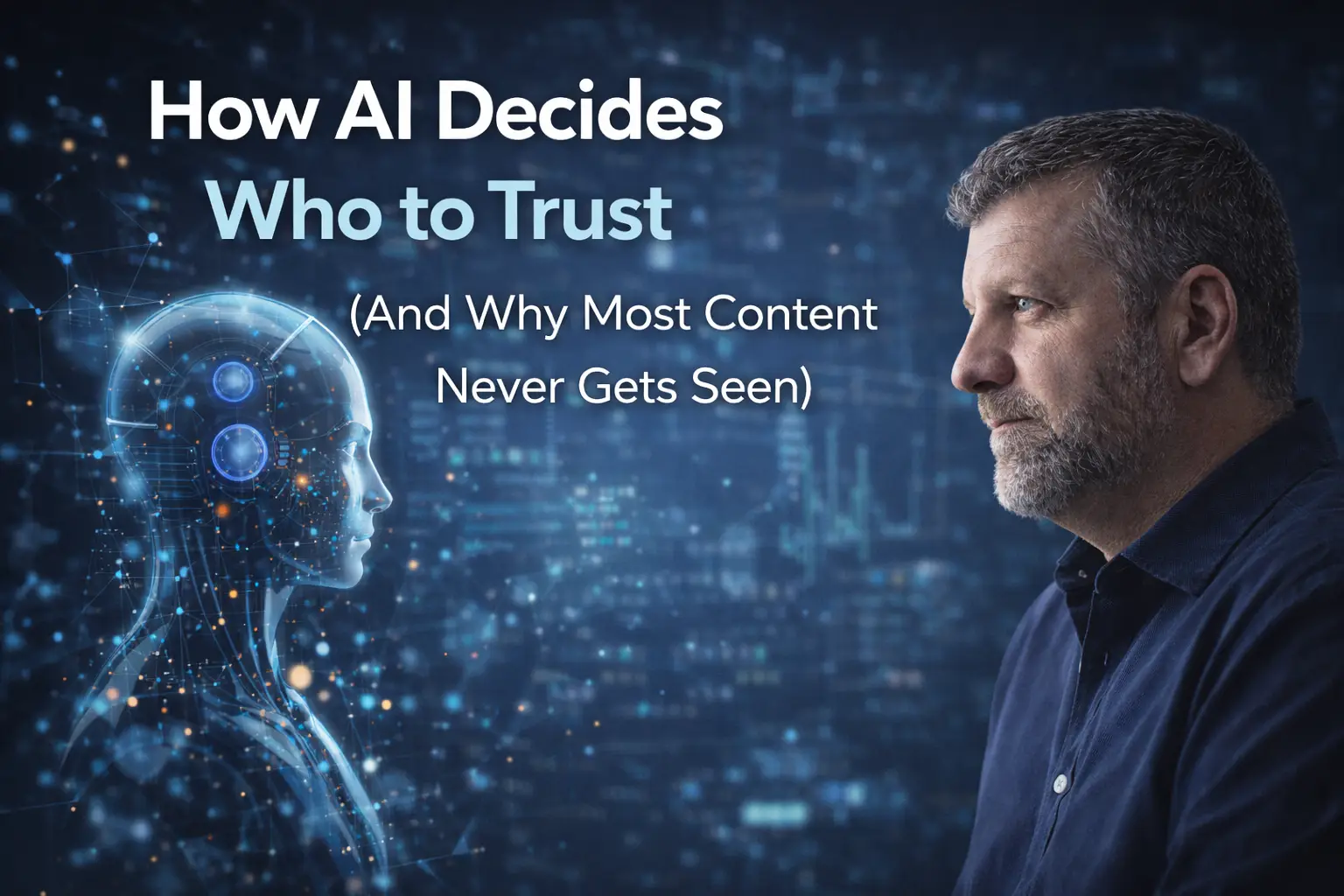
There’s a quiet shift happening in search. It’s not about rankings disappearing. It’s about decision-making moving upstream.
People increasingly arrive at your website — or your Google Business Profile — after an AI system has already helped them narrow options. Which raises a new question businesses aren’t asking yet:
“Why would AI trust us?”
AI Isn’t Searching — It’s Evaluating
Traditional search engines indexed pages. AI systems synthesize answers. That difference matters.
AI doesn’t just look for:
- Keywords
- Backlinks
- Metadata
It looks for signals that answer a deeper question:
- “Is this source reliable enough to summarize, cite, or recommend?”
If the answer isn’t clear, the content gets ignored — even if it technically “ranks.”
Trust Is Built From Patterns, Not Pages
One of the biggest misconceptions is that AI evaluates content in isolation. It doesn’t.
AI looks for:
- Consistency across pages
- Alignment between claims and evidence
- Clear authorship and point of view
- Repeated demonstrations of expertise
- Agreement with other trusted sources
A single strong article helps. A coherent body of work builds trust. That’s why strategy-first content matters so much here.
What AI Struggles With (And Quietly Avoids)
AI systems tend to downplay content that is:
- Vague
- Overly promotional
- Hedged to death
- Written to please algorithms instead of people
- Trying to sound authoritative without saying anything specific
Phrases like:
- “In today’s digital landscape…”
- “Businesses should consider…”
- “There are many factors to think about…”
Sounds safe — but they’re trust killers. AI prefers content that commits.
Clarity Beats Cleverness Every Time
Here’s something counterintuitive:
- AI often trusts plain, direct explanations more than polished marketing copy.
Why? Because clarity signals understanding.
Content that says:
- “Here’s how this actually works — and here’s where it doesn’t.”
Outperforms content that tries to impress. Expertise isn’t loud. It’s precise.
Why Opinions Matter More Than Ever
Neutral content used to feel “safe.” Now it feels invisible.
AI systems look for:
- Judgment
- Tradeoffs
- Limitations
- Context
An expert who says:
“This works in these situations, and fails in these others.”
Is far more trustworthy than one who claims universal solutions. That’s not branding advice. That’s how intelligence works.
The Role of Identity and Attribution
Another shift most businesses miss:
- AI prefers attributable expertise.
Content tied to:
- A real person
- A consistent voice
- A recognizable point of view
Carries more weight than anonymous, generic output. This is why thought leadership — not just content marketing — is becoming critical. AI doesn’t trust faceless authority. Neither do people.
This Is Where Strategy Shows Up Again
Notice the pattern. AI trust isn’t about:
- Publishing more
- Optimizing harder
- Chasing trends
It’s about:
- Knowing what you stand for
- Being clear about who you help
- Repeating the right ideas consistently
- Making your expertise legible
That only happens when strategy comes first.
What This Means Practically
If you want AI systems to surface your business:
- Stop trying to cover everything
- Start building depth around what you know best
- Write to explain, not to impress
- Be specific, even if it means narrowing your audience
- Let your experience show
AI isn’t looking for perfection. It’s looking for confidence rooted in reality.
The Bottom Line
AI doesn’t “rank” trust. It infers it.
- From patterns.
- From consistency.
- From clarity.
- From judgment.
If your content doesn’t clearly signal expertise, AI has nothing to anchor to.
And in a world where AI helps people decide before they ever click, trust is the real visibility metric.