For a long time, the website was the center of the digital universe. Everything pointed there. Everything depended on it. That’s no longer true — especially for local businesses.
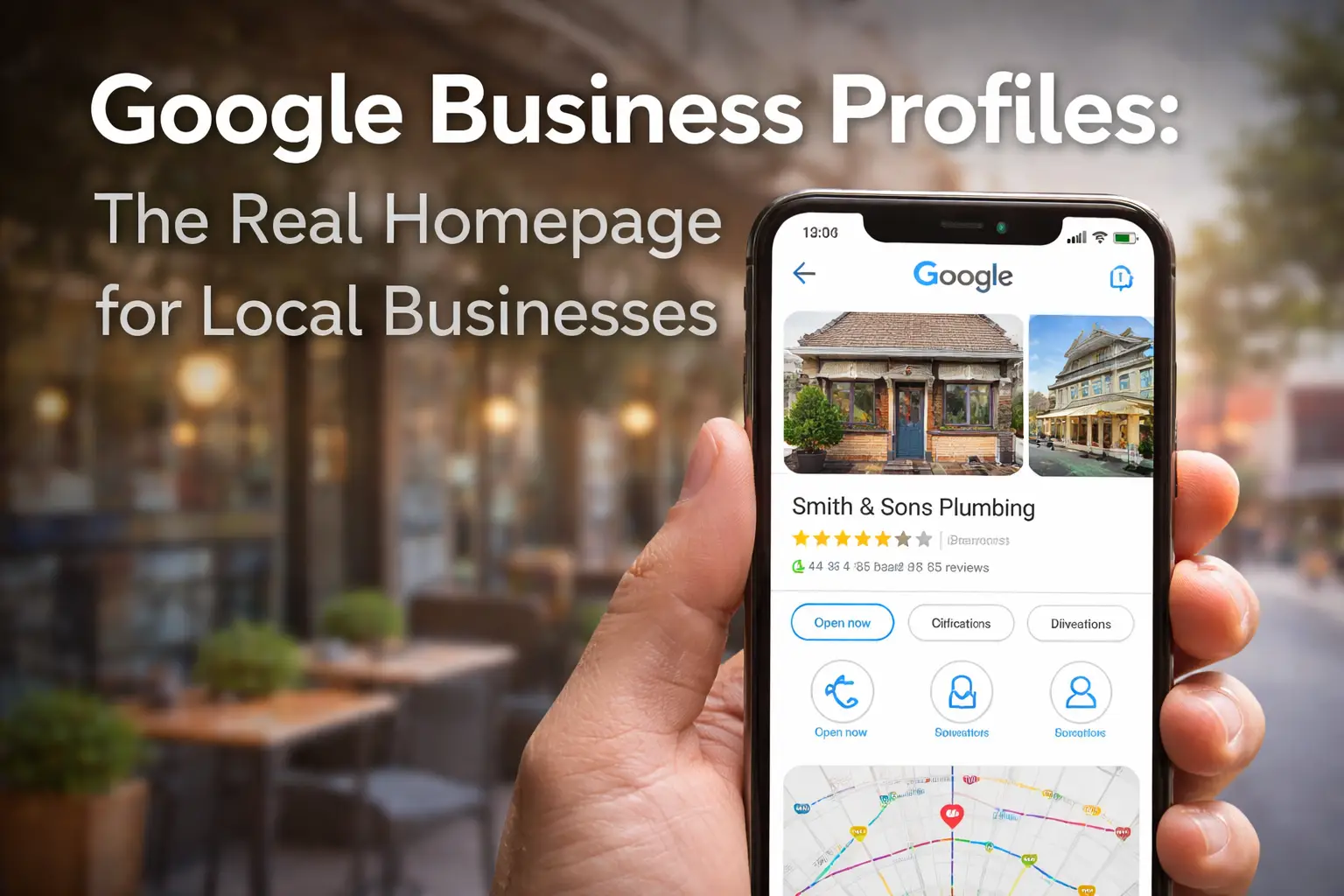
Today, the first real interaction most customers have with a business isn’t a homepage. It’s a Google Business Profile. And most businesses still treat it like a listing instead of what it actually is: their real homepage.
Where Local Decisions Actually Happen
Think about how people really search locally.
They don’t say:
“I’d like to explore the website of a nearby business.”
They say:
- “best [service] near me”
- “open now”
- “reviews”
- “phone number”
- “directions”
What shows up first isn’t your carefully designed homepage. It’s your Google Business Profile — photos, reviews, hours, description, Q&A, and proximity. Decisions start forming before a click ever happens.
Visibility Without Context Is a Problem
A lot of businesses technically “show up” on Maps. But when you look closer:
- The description is vague
- The photos are outdated or random
- Services aren’t clearly defined
- Reviews aren’t contextualized
- Nothing answers the unspoken question:
“Is this right for me?”
That’s being found without being chosen.
Google Business Profiles Are a Filtering Tool
This is the part most people miss. Google Business Profiles don’t just surface options — they filter them.
Users scan:
- Star rating
- Review language
- Photo quality
- Responsiveness
- Clarity of services
- Signs of legitimacy and care
If something feels off, they don’t dig deeper. They move on. Your website never gets a chance.
Why SEO Can’t Save a Weak Profile
I see this all the time:
- A business invests in SEO.
- Traffic improves.
- Local visibility increases.
But conversions lag.
When we look closer, the issue isn’t keywords or rankings — it’s the Google Business Profile acting as a bottleneck.
If the profile doesn’t:
- Reinforce positioning
- Match website messaging
- Set expectations clearly
SEO ends up feeding a leaky funnel.
What Strong Profiles Do Differently
High-performing Google Business Profiles aren’t “optimized” in the checkbox sense. They’re intentional.
They:
- Clearly state who they’re for
- Emphasize the most important services
- Use photos that reflect reality (not stock)
- Highlight reviews that tell the right story
- Answer questions before they’re asked
They reduce uncertainty. And reducing uncertainty is what drives action.
This Is Strategy, Not Just Setup
Anyone can fill out a profile. Very few businesses think strategically about:
- What story the reviews tell
- Which services deserve emphasis
- What photos communicate trust
- How the profile supports — not competes with — the website
That thinking matters more than any single ranking factor.
AI Is Paying Attention Here Too
This matters even more now. AI-driven search experiences pull heavily from:
- Google Business Profiles
- Reviews
- Business descriptions
- Consistency across platforms
If your profile is sloppy, generic, or outdated, AI systems don’t have much confidence to work with. Trust signals start here.
The Bottom Line
For local businesses, the website is no longer the front door.
The Google Business Profile is.
If it’s unclear, underdeveloped, or treated as an afterthought, you’re losing business quietly — and consistently — without ever knowing why.
You don’t get chosen locally without earning trust first.
And trust now starts on Maps.